Developing future-ready leaders
Organizations that rethink a few aspects of their executive development programs will have the best chance of developing leaders who will help them thrive now and deliver a sustainable and resilient future.


11 Min Read
As companies wrestle with new business models and ways of working and make stronger commitments than ever to purpose, sustainability, and diversity and inclusion, they need leaders who are constantly ready for anything, who can have impact today and also evolve with the organization. In part, that means leaders who consider the impact of their strategy across a triple bottom line: people (employees, customers, suppliers, and communities), planet (sustainability and net zero), and profits.
Such mandates go well beyond the traditional qualifications for leaders. And most executive development programs have not necessarily kept pace with these evolving expectations. Programs that target high-potential executives very often focus on those who drive the strongest financial results. Others focus on building specific functional skills. These are, of course, necessary but no longer sufficient, given that financial performance alone no longer meets shareholders’ or other stakeholders’ expectations. It’s telling that, among all 33 leadership capabilities we consider, the one that executives at all levels score the lowest is developing strong leaders for the future. (For more on how companies can seek to hire leaders with these capabilities, see “Future-ready leaders: Finding effective leaders who can grow with your company.”)
But it is possible to develop leaders who can do it all, and some companies are leading the way. Through our extensive work with organizations globally and our in-depth research on how leaders lead, we’ve generated a comprehensive and data-driven understanding of the capabilities executives possess when they are seen by their colleagues as having both impact today and potential for future growth. We also have suggestions on ways organizations can help executives develop these capabilities alongside functional skills so they can be ready for anything to help their organizations thrive.
The new demands on leaders—and the capabilities needed to meet them
We have assessed more than 3,000 high-level executives over the past two years and, as part of this research effort, we have been gathering gathering the views of more than 30,000 of their colleagues on how they lead, the impact they have, and how much potential they have. We based this analysis on characteristics we know accelerate organizational performance: mobilizing, executing, and transforming with agility, or META. At a high level, organizations that succeed across all the aspects of META are able to adapt and pivot faster than competitors in areas where doing so adds value—critical capabilities in an ever-changing world.
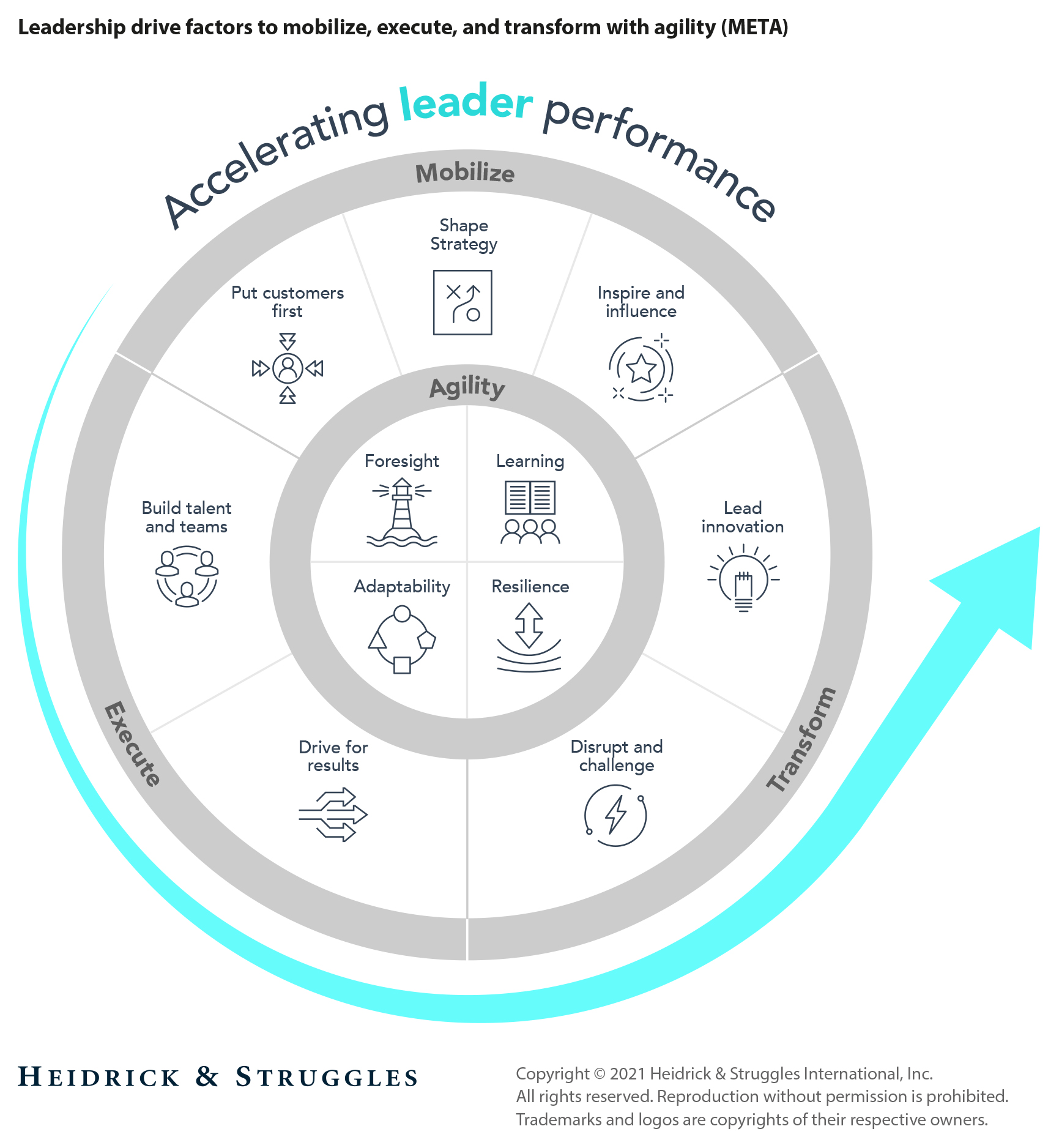
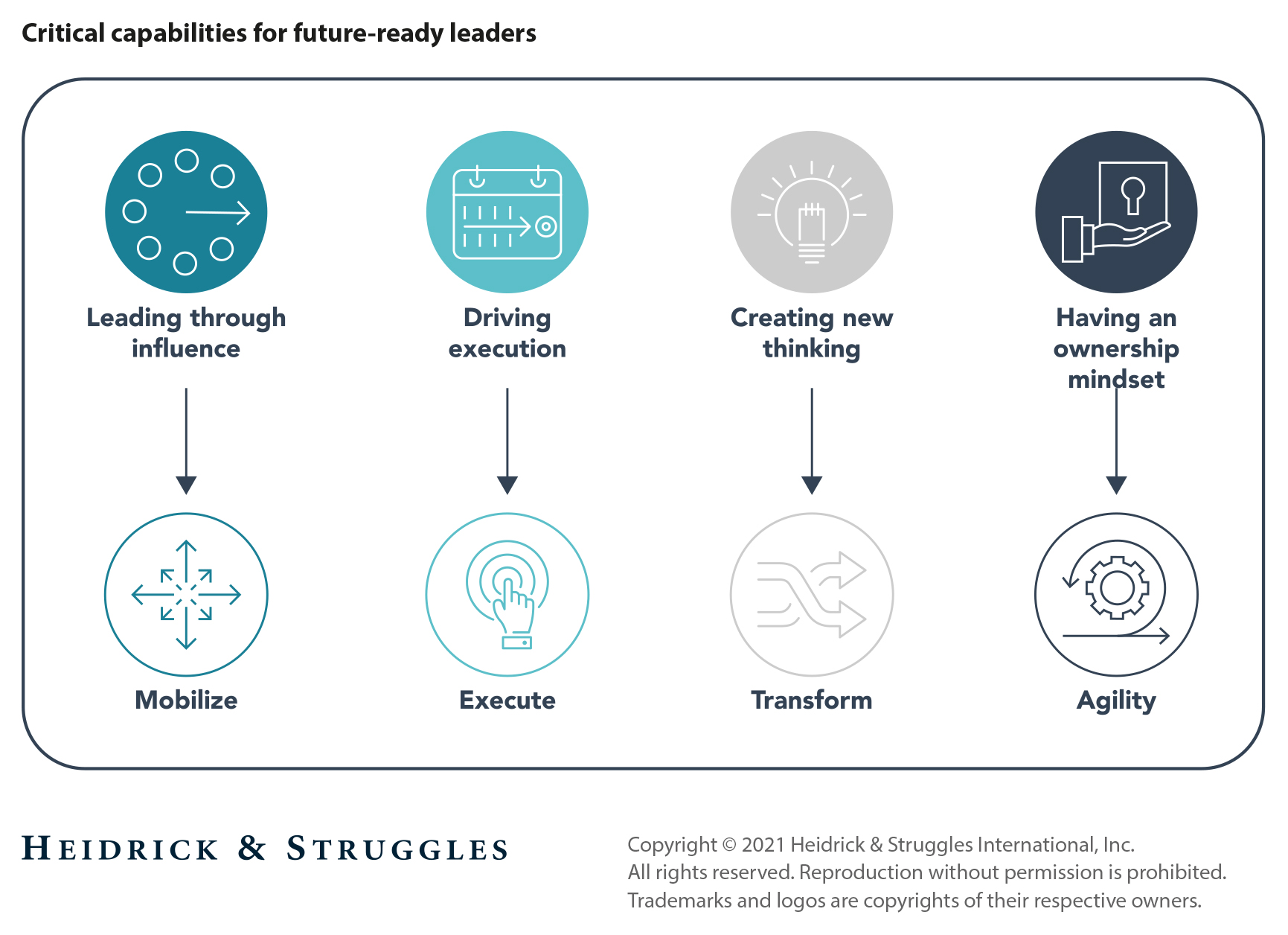
Among 33 leadership capabilities that make up a leader’s ability to mobilize, execute, and transform with agility, underlying the broad categories shown in the META wheel, we have identified four that are particularly critical for leaders to meet the expectations of stakeholders inside and outside the organization, and to be able to evolve so they continue to have impact in the future. They fall one in each of the four areas of META: leading through influence (mobilize), driving execution (execute), creating possibilities from new thinking (transform), and having an ownership mindset (agility).
Why these capabilities?
When taken together, these four capabilities allow leaders to build strong, trusting, inclusive relationships across their firms, which helps their new ideas get heard and supports resilience on their teams. We call these leaders future-ready because they are ready for anything. Indeed, the fact that these capabilities were the same before and throughout the COVID-19 pandemic underscores this point—and just how fundamental they are. It is also notable that future-ready leaders are well rounded: they can mobilize, executive, and transform, all with agility.1
Leading through influence: Leaders who rely on influence rather than authority to get things done are more effective at encouraging people to connect to the organizational purpose, which in turn energizes people inside and outside the organization to feel they are part of something bigger and are positively contributing. This approach also encourages inclusion and builds trust among leaders and employees—and allows these leaders to work more effectively with both their teams and more senior executives, as well as the wider ecosystem in which their companies operate. (For more on the capabilities of inclusive leaders, see “What inclusive leaders do—and don’t do.”)
Driving execution: Being able to drive execution is fundamental to meeting the triple bottom line and building trust across the organization and the wider community. Leaders who are good at execution are able to make tough decisions that benefit the whole ecosystem—as well as progress—on pressing topics and in the face of complex and novel challenges.
Creating new thinking: Since the beginning of the COVID-19 pandemic, and its dramatic effect on business operations, we have seen workers show an increased preference for working in teams rather than independently. This suggests an emotional need for connection but also an operational one, in that people increasingly recognize they can do more together than apart and that the converging of differing perspectives, inside and outside the organization, can yield fresh insights. And inclusion is central to making such teams work and getting the most out of them.
Having an ownership mindset: Leaders with an ownership mindset take responsibility not only for results but also for their success or failure. This mindset is central to resilience, one of the key elements of agility. It matters because feeling that they can take responsibility rather than being buffeted by events helps leaders continue to move forward. These leaders take into account factors such as how well the organization treats employees and other stakeholders and how well it is meeting expectations in addition to financial metrics. This ownership mindset inspires trust across the organization and in the wider ecosystem; creates a culture of accountability, which can help drive results; and bolsters inclusion on the team.
How to help leaders develop these capabilities
While some leaders or prospective leaders may inherently have some of these capabilities or have naturally developed them, others may need to learn them or be coached on why they’re important or how to develop the courage to advocate for a world better led. However, most organizations focus on other aspects of leadership in their executive development programs. This may be because they are not entirely sure what capabilities beyond the hard skills related to a specific role are needed or because they simply don’t know how to help prospective and existing leaders develop them. In addition, we have seen that sitting CEOs and executive teams may have to shift their own mindsets as part of this process, from one of developing successors and teams in their own mold to seeking people who may be quite different.
Shifting mindsets more broadly is at the core of building new capabilities. Our work has shown that mindsets that encourage the four crucial leadership capabilities that we have identified include ecosystem thinking, curiosity, adaptive thinking, open-mindedness, collective ownership, and believing the whole is greater than the sum of its parts. Companies can help aspiring or existing leaders develop these mindsets and capabilities in a few ways:
Addressing bias
Addressing negative bias focuses on people's tendency to fixate on bad news or bad results. (This is different from bias training related to diversity, equity, and inclusion efforts). This kind of training tends to open leaders’ minds and can consequently increase trust and inclusion among teams. It can put leaders in a position to lead through influence and create new thinking by tapping more and diverse perspectives. Tim Munden, the chief learning officer of Unilever, recently said, “Our job as leaders is to set direction, define parameters, and then let people run with it. But there are plenty of things that can get in the way of that. Fear, insecurity, uncertainty.” He advocates focusing on leaders’ individual ways of being and their motivations just as much as on what they do, to ensure they are leading in a way that reflects the interconnections of today’s expectations.2
Bias training that is related to DE&I efforts is also often important in developing leaders who can build trust and inclusion and create new thinking. Such training in itself will not create those leaders, nor should it be used as a small patch while more systemic issues are allowed to take hold. That said, this training can unlock leaders' thinking. The chair of a global pharmaceutical company, for example, recently noted that such training can help people appreciate someone else's reality by walking in his or her footsteps and challenging individual assumptions.
Role-modeling by current leaders
Current leaders have a critical role to play in showing newer leaders how to lead through influence, drive execution, create new thinking, and embrace an ownership mindset. Beyond helping other leaders develop, role-modeling underscores leaders’ commitment to purpose and values. One important tactic is to commit to valuing people’s individual contributions, enabling them to bring their best selves to tasks and help the company deliver on its purpose. For example, Dan Price, the CEO of Gravity Payments, shocked the business world by raising the minimum salary at the company to $70,000, which was a doubling of wages for some employees, and cutting his own pay by 90% in order to help fund the increase. Since then, the head count has doubled, the value of payments processed by the company has nearly tripled, and the amount of money employees are able to save for retirement has more than doubled.3 And in 2020, many CEOs took pay cuts, particularly in industries where they were furloughing or laying off large numbers of workers.
Leaders can also role-model an ownership mindset by taking risks and being open about when they make missteps or when something does not pan out the way they’d planned. In addition, actively challenging people to develop innovative solutions and supporting them in doing so—for example, through hackathons or setting aside dedicated time for creative thought—are ways leaders can encourage both an ownership mindset and new thinking.
Individual and small-group coaching
For many leaders, individual and small-group coaching will be the most effective way strengthen leadership capabilities that exist to some extent and, where needed, shift mindsets regarding their importance. Such coaching will also help leaders build coaching skills themselves, and they can then harness and cascade the same capabilities to their teams. Identifying leaders at all levels who want to engage with leading in this way will help ensure companies have a deep bench. Using multiple data points (for example, engagement, assessment, performance, and cultural impact) will help identify those leaders. One global bank is using small-group coaching among senior executives from different functions and business units. The leaders share their perspectives on how they are bringing their strategic priorities to life. By listening to each other’s perspectives, rather than executing priorities silo by silo, the leaders have found that they are reflecting on their own behavior as leaders, and how they reach their priorities, much more deeply than ever before. This is helping them bring the whole organization to strategic execution. A global technology company has had much the same experience. And, in both cases, such small-group coaching has helped leaders develop and lead with a coaching mindset that can bolster the entire organization.
About the authors
TA Mitchell (tmitchell@heidrick.com) is a principal in Heidrick' London office and a member of Heidrick Consulting.
Sharon Sands (ssands@heidrick.com) is the leader of Leadership Development, Assessment, and Coaching for Heidrick Consulting and a member of the CEO & Board Practice; she is based in the London office.
Naomi Record (nrecord@heidrick.com) is a principal in Heidrick' London office and a member of Heidrick Consulting.
Acknowledgments
The authors wish to thank Ryan Pastrovich for his contributions to this article.
References
1 Colleagues also consistently note three behaviors that hold leaders back now and undermine their potential: not taking ownership for shaping the work environment, having difficulty flexing between detail and the big picture, and being disorganized.
2 Rasmus Hougaard, “How the world’s biggest organizations are developing leaders for a post-pandemic world,” Forbes, July 7, 2021.
3 Nicole Fallert, “CEO who raised company minimum wage to 70K says revenue has tripled,” Newsweek, April 14, 2021, newsweek.com.
As companies transform their business models and ways of working, respond with agility to internal and external change, and make stronger commitments than ever to purpose, sustainability, and diversity and inclusion, having effective leaders is critical. It’s becoming increasingly clear that the skills and strategies that once made for successful leaders are no longer enough—and this reality will likely become only more pronounced. By understanding the capabilities that are a hallmark of the most effective leaders—that is, the ability to lead through influence, drive execution, create new thinking, and embrace an ownership mindset—companies can start developing leaders who will not only be better prepared for today but also ready for whatever the future holds.
Related services & industries
Related Content
- Read More
Report
Guide to Working with On-Demand Talent
- Read More
Gender inclusivity in the pharmaceutical industry: An interview with Kanako Kikuchi, president of UCB Japan
Kanako Kikuchi, president of UCB Japan, discusses her career journey and offers advice to young female leaders on advancing their careers. - Read More
Leadership perspectives: An interview with Lawrence Lam, CEO of Prudential Hong Kong
Lawrence Lam, CEO of Prudential Hong Kong, discusses the path to becoming CEO and offers advice to aspiring leaders.
- Read More
Leadership, breaking through, and the value of communications: An interview with Sally Susman, chief corporate affairs officer of Pfizer
Sally Susman shares her insights on what skills are most important as a leader, particularly a communications leader, as well as the value in humanity, humility, and humor. - Read More
Bonus conversation: Trends in private equity talent needs across North America
This short, bonus episode features Heidrick's partners Jason Henderson and Sean McLean as they discuss the trends they are seeing in private equity talent. - Read More
Energy, policy, and purpose: A conversation with Jennifer Granholm, former US Secretary of Energy
Jennifer Granholm discusses what leadership looks like in the context of the global energy transition.
- Read More
How the general counsel role is changing in 2023
Four sitting general counsels share their insights on how current and aspiring GCs can be most effective as their role continues to expand and shift. - Read More
CEO and board confidence monitor 2025: Persistent concerns, pockets of increased confidence
Our second annual survey of CEOs and board members at companies around the world highlights a persistent set of significant concerns and a continued lack of confidence in leadership pipelines. However, the results also show that companies have made progress in addressing some of their longer-term concerns. - Read More
The connecting leader: Five imperatives for leaders today
How are leaders around the world leveraging connecting capabilities to help their organizations thrive? Our research shows that effective leaders share core capabilities rooted in authentic connection—the ability to inspire, influence, learn, adapt, and support their team’s professional growth. By unifying diverse teams, guiding change, and fostering growth, they create positive impact for all stakeholders and elevate their teams, organizations, and ecosystems in both the short and long term. These leaders leave a lasting legacy on their people, their organizations, and the world.

- Read More
First-time chief people officers: A guide from current to future chief people officers
The chief people officer (CPO) report outlines the step changes that people face when they get into the CPO role, some of which they may previously have considered, and others that fall far outside their sphere of experience. - Read More
Chief people officer monitor: Building HR functions that are effective <em>and</em> strategically influential
CPOs say their functions are, on the whole, moderately successful at both traditional HR activities and having strategic influence, according to a recent survey and insights from leading CPOs in markets around the world. The research suggests a few priorities for focus as CPOs reshape their functions for the future. - Read More
Chief people officer focus: How CPOs in the Middle East are evolving the HR function
As the competition for talent heats up in the Middle East, companies are seeking greater alignment between their business goals and people priorities and are repositioning their HR function closer to the decision-making center. Insights from HR leaders across the region highlight key focus areas and competencies to succeed

- Read More
Biotech focus: Finding CFOs for booming companies
For fast-growing biotech firms, CFOs with public company experience are increasingly important—and difficult to find. CEOs and boards who rethink where to find that expertise are more often finding the people they need, and finding them faster. - Read More
Creating next-generation CHROs
The role of the CHRO is changing fast. We offer five lessons from some of the world’s most digitally enabled human resources leaders. - Read More
Article
Route to the Top 2019: Interview with Severn Trent CEO Liv Garfield
Liv Garfield, CEO of Severn Trent, shares her thoughts on the challenges she has faced and lessons learned and how she sees the CEO role evolving.
- Read More
Leading across boundaries: Four approaches leaders are taking today in context
Dig deeper into four approaches to leading across boundaries and how they vary by market, company ownership, sector, and size. - Read More
The composition of US unicorn 100 executive teams: A first look
Our first study of key roles on the executive teams of US unicorns—start-ups valued at least $1 billion at the end of 2022—finds a different mix of racial and ethnic diversity than at Fortune 100 companies and a higher tendency to hire externally. - Read More
Article
Route to the Top 2020: Interview with Jean-Christophe Tellier, CEO of UCB
Jean-Christophe Tellier, CEO of global biopharmaceutical company UCB, discusses the evolving role of the CEO, the impact of COVID-19 on the industry, and UCB’s sustainability agenda.

- Read More
Chief sustainability officer focus: A European CSO perspective on driving the sustainability agenda
What makes the chief sustainability officer role effective and who makes an excellent candidate? We spoke to 17 chief sustainability officers from leading European companies to find out. - Read More
Hiring social sector CEOs: Three ways boards should engage employees
To make a social sector CEO search successful, boards and leaders should work to align their purpose with their employees, balancing employee perspectives with the financial, legal, and governance needs of the organization.